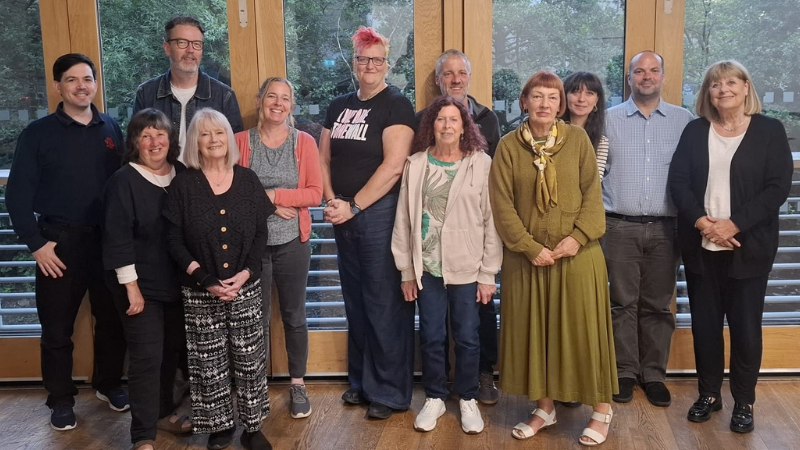
In short, councillors work together to set the policy direction of the Town Council. Councillors attend regular meetings of the council and its committees to make decisions on a range of matters deciding what services should be delivered, where money should be spent and what policies should be implemented.
Councillors represent the local community, both residents of their ward and Hebden Royd as a whole. Councillors will be contacted by residents who have problems they need assistance with and some councillors are appointed to serve on outside bodies, such as Hebden Bridge Flood Alleviation Stakeholder Group, Mytholmroyd Station Partnership and Hebden Royd Business Forum.
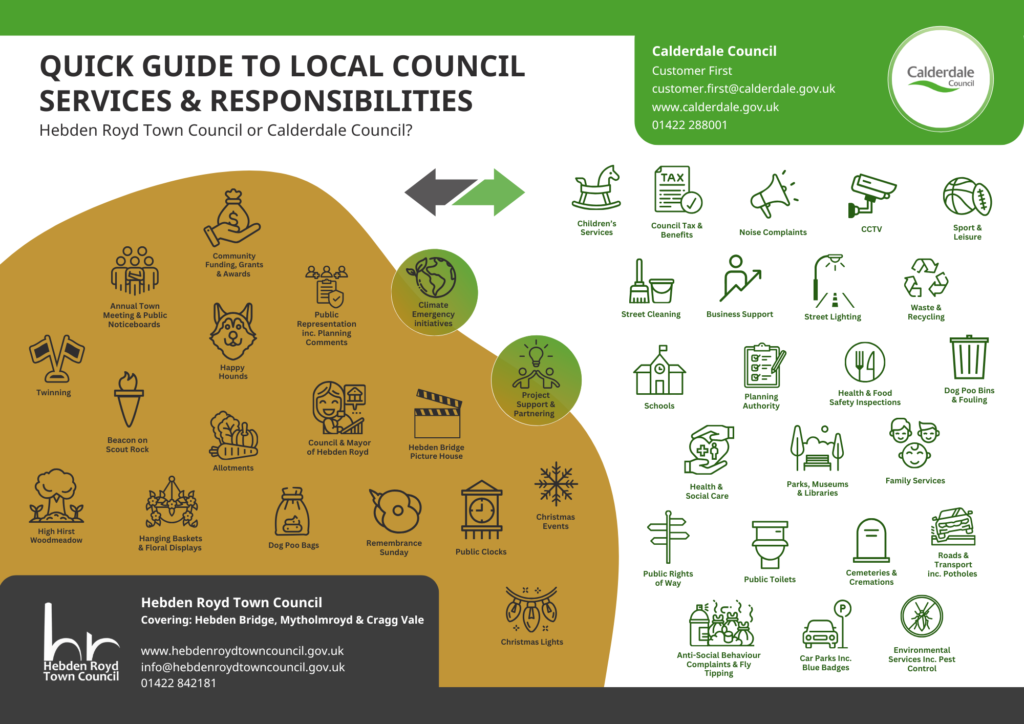
As a Town Councillor, there are certain things you can, and cannot, influence.
The diagram below shows how the Town Council’s responsibilities interact with the County Council’s responsibilities.
Where matters are not the direct responsibility of the Town Council but are pertinent to our community, we seek to work in close partnership with Calderdale Council.
Elections are held for all 18 seats on the Council every four years.
Elections are held for all 18 seats on the council every four years. The last full election took place in May 2023 and five wards were uncontested.
There are three ways to become councillor:
- Ordinary Election
Ordinary elections are held every four years and this is when all 18 seats on the council are up for election. Councillors serve a four-year term. The next ordinary elections are in May 2027
- By-Election
If a vacancy arises between ordinary elections a by-election may be held for that one seat. The elected councillor will serve the remainder of the term and retire with other councillors at the next ordinary election.
A casual vacancy could arise through resignation, death, disqualification or by failing to attend meetings.
When a casual vacancy arises, the Town Clerk will publish a notice giving the electors living in the ward 14 working days the opportunity to demand an election. If 10 electors write to the Returning Officer at Calderdale Council to request an election, a by-election is triggered.
If fewer than 10 request an election, the town council must instead co-opt a councillor to fill the vacancy.
If the vacancy occurs within the 6 months before an ordinary election no by-election will be held even if demanded. If a by-election is not demanded the council can choose to leave the vacancy unfilled until the election.
- Co-option
If an insufficient number of candidates stand for an ordinary election leaving seats vacant, or a by-election is not triggered when a casual vacancy arises, the existing councillors may vote to co-opt a councillor to serve the term.
Elections to Hebden Royd Town Council are run by Calderdale Council (the elections authority). Standing for election is the same for ordinary elections and by-elections and the Electoral Commission website has full resources that explain the rules in more detail. The detailed timeline for an election will be set out in the formal notices. If you are intending to stand as a candidate for a political party you should contact the party in advance.
A formal notice of an election will be given by Calderdale Council. This will be published on the town council’s noticeboard and website. The notice will give a date from which nomination papers can be submitted.
Nomination papers can be downloaded from the Electoral Commission website or Electoral Services at Calderdale Council. Candidates have from the day after the notice until around one month before an election to submit their nomination papers to the Returning Officer at Calderdale Council – there is often a window of around a week between the notice and the deadline for nominations. Nomination papers must be hand delivered and completed fully. They must also include signatures of two registered electors (known as a proposer and seconder) from the Ward.
You will also need a witness to confirm you have consented to the nomination and provided your correct information. If you are standing as a party representative, they must sign to consent to your nomination.
You can find more information on submitting your nomination papers on the Electoral Commission website.
By the day after the close of nominations, a ‘statement of persons nominated’ will be issued by Calderdale Council, which lists who has stood for election and who has proposed them. This will be followed by the ‘notice of poll’ which confirms the detail of the election.
There are detailed rules on campaigning and election spending. Candidates should read the guidance from the Electoral Commission.
When the votes are counted depends on what other elections are running on the same day. The Returning Officer at Calderdale Council will let candidates know when the votes will be counted and candidates can attend the count.
The Electoral Commission website contains the detailed and official advice for candidates in elections. We recommend that if you are interested in putting yourself forward to become a Town Councillor you read their guidance after this page.
FREQUENTLY ASKED QUESTIONS
No, our councillors do not receive an allowance. The exception to this is the Town Mayor who receives an allowance to meet the expenses of that office.
The Town Clerk provides an induction for all new councillors and part of this role is to provide advice and support to all councillors. Experienced councillors are often happy to support new councillors whilst they settle into their new role.
We encourage councillors to undertake training relevant to their roles and the needs of the council and councillors have access to advice from Yorkshire Local Councils Association.
Hebden Royd is divided into six wards: Birchcliffe, Caldene, Fairfield, Cragg Vale, West End and White Lee.
It is the electors of the ward who vote in any given election, a councillor does not have to live in the ward they stand in.
In any election, you can only stand once i.e. in one ward. If you stand for more than one you will be not be validly nominated in either. However, you are not tied to a ward, so if you stand for election in Caldene ward in one election, you could stand in Fairfield ward at the next.
https://hebdenroydtowncouncil.gov.uk/your-council/town-council/wards/
The town council is apolitical, though some councillors are affiliated with a political party. You do not need to be a member of a political party to be a Town Councillor.
Councillors can stand for election (or co-option) as candidates for a political party, to do so they must have permission from the party, usually through the local branch.
To be able to stand as a candidate at a Hebden Royd Town Council election you must:
- be at least 18 years old.
- be a British citizen, an eligible Commonwealth citizen, a citizen of the Republic of Ireland, a qualifying EU citizen or an EU citizen with retained rights.
- meet at least one of the following four qualifications:
- You are, and will continue to be, registered as a local government elector for Hebden Royd from the day of your nomination onwards. More information: ‘Being a registered local government elector’.
- You have occupied as owner or tenant any land or other premises in Hebden Royd during the whole of the 12 months before the day of your nomination and the day of election. More information: ‘Occupying as owner or tenant any land or other premises in the local authority area’.
- Your main or only place of work during the 12 months prior to the day of your nomination and the day of election has been in the Hebden Royd area. More information: ‘Your main or only place of work is in the local authority area‘.
- You have lived in Hebden Royd or within three miles of it during the whole of the 12 months before the day of your nomination and the day of election. More information: ‘Living in the parish area (or within three miles of it)’.
Detailed guidance on qualification and disqualification can be found on the Electoral Commission website.
Vacancies and Election Notices
Any open vacancies or elections will appear below